Ever wonder what’s really going on in your mind and body during a flow state, when it feels like time slows down and everything just clicks?
During the 1992 NBA Finals, Michael Jordan hit seven threes in a row against the Portland Trail Blazers, scoring 35 points in the first half alone. By his seventh shot, he could only shrug, a performance so far above expectations that even Jordan seemed stunned by it (Bell, n.d.). Sport psychologists call this a flow state. Most athletes just call it being in the zone.
In 2015, 18-year-old Katie Ledecky broke her own world record in the 1500-meter freestyle at the World Championships in Russia. Afterward, she casually described the race: “To be honest, it felt pretty easy. I was so relaxed” (Duckworth, 2016). That’s what flow state looks like. As Duckworth (2016) put it, “Flow is performing at high levels of challenge and yet feeling ‘effortless,’ like ‘you don’t have to think about it, you’re just doing it.'”
Bill Russell, who won eleven NBA championships with the Celtics, described that same feeling in his memoir: “Almost as if we were playing in slow motion. During those spells I could almost sense how the next play would develop and where the next shot would be taken.”
Csíkszentmihályi (1990) first described the flow state as one where the internal chatter goes quiet, movement feels effortless, and time seems to bend. It’s the experience of losing yourself completely in what you’re doing.
“Flow is being completely involved in an activity for its own sake. The ego falls away. Time flies. Every action, movement, and thought follows inevitably from the previous one…” Csíkszentmihályi, 1996
One of the biggest misconceptions about flow is that it’s random, a stroke of luck that either shows up or doesn’t. In reality, flow has conditions. You can build the circumstances that make it more likely to happen, even if you can’t force it directly.
It’s also easy to read stories about Jordan, Ledecky, and Russell and conclude that a flow state only happens to Olympians or superstars. That’s not true. You don’t need to be an expert in your craft to experience flow. Csíkszentmihályi (1990) found the experience is universal across ages and experience levels. It shows up in sport, music, gaming and gardening.
Understanding the science behind flow, and what makes it more likely, gives you something to train for, not just hope for.
The Nine Characteristics of a Flow State
Flow researchers break the experience down into nine core characteristics: three that set up the conditions for flow, and six that describe what it feels like once you’re in it (van der Linden, Tops, & Bakker, 2021; Jackson & Csíkszentmihályi, 1999). You don’t need all nine present at once to be in flow, but the more that show up together, the deeper the state tends to feel.
What sets up the conditions:
- A balance between challenge and skill. You’ve evenly matched.
- Clear goals. You know exactly what you’re aiming for.
- Immediate feedback. You instantly know whether what you just did worked.
What flow feels like:
- Total concentration on the task. You are entirely focused on the moment.
- Actions and awareness merge. You stop judging your performance and just play.
- A feeling of control. Not control over the outcome, which you can never fully control, but a sense of control over your own ability and performance.
- Loss of self-conscious rumination. Your self-doubt dissolves away.
- A transformation of time. Time either speeds up or slows way down, the way Bill Russell described above.
- The experience is intrinsically rewarding. You’re doing it because it feels good to do, not for the outcome attached to it. In otherwords, it feels good and you enjoy it.
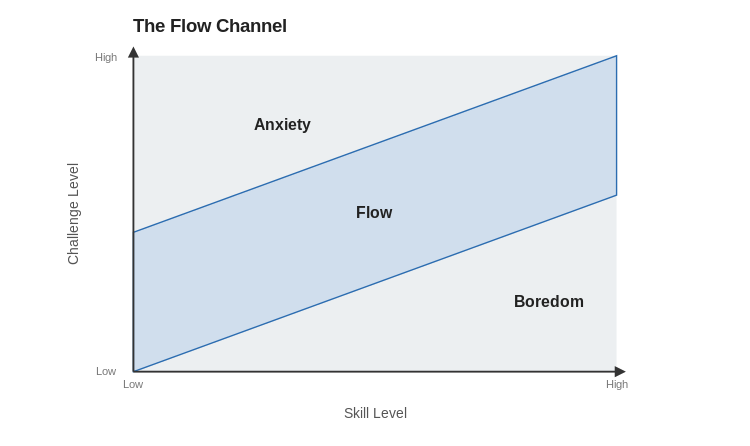
The Flow Channel
Sport psychologists often picture flow as a channel running between two extremes, based on the relationship between the challenge in front of you and your skill level to meet it.
Anxiety. When the challenge outweighs your skill, you tighten up. Your thoughts race ahead to the outcome, your body stays tense, and you play defensively and tentatively instead of aggressively.
Boredom. When your skill outweighs the challenge, your attention drifts. Without enough to engage you, your mind wanders off the task in front of you. You lose focus and motivation wanes.
Flow. When challenge and skill are in balance, something shifts. Action and awareness merge. You stop thinking about what you’re doing and simply do it (Jackson & Csikszentmihalyi, 1999).
It is not a realistic goal to eliminate anxiety or boredom from competition entirely. The goal is to increase awareness of which side of the channel you’re on and adjust: raise the challenge when you’re bored, or narrow your focus when you’re anxious.
What Makes an Environment That Supports a Flow State
Flow doesn’t happen in a vacuum. There are specific conditions make it far more likely occur (Jackson & Csikszentmihalyi, 1999):
Clear and specific goals. Vague goals like “play well” give your mind nothing concrete to lock onto. Flow depends on knowing exactly what you’re trying to do in this specific moment, this next play, this race. Specificity matters.
Immediate feedback. You need to know, in real time, whether what you’re doing is working. That might be as simple as watching the ball land where you want it to, or being mindful of your split times as you race.
A challenge that matches your skill. Not too hard, not too easy. You need to be pushed, but not beyond your capabilities. This is the same balance that defines the flow channel above.
A sense of control. Athletes drop into a flow state more easily when they trust their preparation and feel in control of their performance.
Feeling safe. Athletes who are worried about being watched, judged, or criticized, whether by a coach, a crowd, or their teammates, have a much harder time letting go enough to find flow. You need to believe that you belong.
Coaches and teams should strive to build team environments that support all five of these conditions.
Obstacles to Acheiving a Flow State
Just as certain conditions invite flow, there are also predictable patterns that block it.
Overthinking. The moment you start judging your own performance in your head, overanalyzing your form, or beating yourself up over the last mistake, you pull yourself out of the moment.
Outcome focus. Thinking about whether you’ll win or lose, will look shifts your attention away from the task directly in front of you and onto something you can’t control in the moment.
Fear of judgment. Worrying about how you’re perceived by your coaches and teammates, whether you look confident enough, aggressive enough, or “team oriented” enough, pulls attention inward in exactly the way flow requires you to let go of.
External distraction. Ruminating on your personal statistics, your playing time, sideline noise, and past conversations all compete for the same attention that flow depends on. They are all threats to your attention.
Physical or mental fatigue. It’s hard to lose yourself in a task when your body is depleted or your mind is already exhausted from poor nutrition, a stressful week, or poor sleep.
Recognizing which of these tends to show up for you the most is often the first step toward managing it.
How to Train for Flow
You can’t force flow into existence on command, but you can build the habits that invite it.
- Set SMART goals you can actually track and obtain. Pick one or two specific, observable targets for a specific competition or performance.
- Build a short, consistent routine before you compete. A pre game ritual signals to your brain that it’s time to narrow focus and readiness your body for peak performance.
- Quiet your inner critic during competition. Practice negative thought replacement strategies or mindful awareness in the moment to silence the negative self-talk.
- Log your flow moments after the fact. So many athletes forget this step. Keep a quick note of games or practices where everything clicked: what led up to it, what you were or weren’t thinking about, what your routine looked like that day. Over time, this becomes a personalized map of the conditions that work for you. You can use this to customize your precompetition routine.
Flow, focus, and confidence are all intertwined with each other. Athletes who trust their preparation, who’ve done the work of building genuine confidence, have an easier time letting go of outcome and dropping into the task in front of them. You can’t think your way into flow and it’s not about luck. You can try to create or re-create the conditions to maximize your chances.
If you’re ready to build a mental training plan that helps you find your zone more consistently, reach out about mental coaching for athletes. I love helping athletes figure out how to reach their potentional and achieve their goals.
Further reading:
- Find Your Zone, Association for Applied Sport Psychology
- Finding Flow: The 9 Dimensions, Dr. Susan Jackson
- Go with the Flow: A Neuroscientific View on Being Fully Engaged, European Journal of Neuroscience
- Grit: The Power of Passion and Perseverance, Angela Duckworth (affiliate link)
References
Bell, R. (n.d.). Find your zone. Association for Applied Sport Psychology. https://appliedsportpsych.org/resources/resources-for-athletes/find-your-zone/
Csíkszentmihályi, M. (1990). Flow: The Psychology of Optimal Experience. Harper & Row.
Csíkszentmihályi, M. (1996). Creativity: Flow and the Psychology of Discovery and Invention. HarperCollins.
Duckworth, A. (2016). Grit: The Power of Passion and Perseverance. Scribner.
Jackson, S. A., & Csikszentmihalyi, M. (1999). Flow in Sports: The Keys to Optimal Experiences and Performances. Human Kinetics.
Russell, B., & Branch, T. (1979). Second Wind: The Memoirs of an Opinionated Man. Random House.
Van der Linden, D., Tops, M., & Bakker, A. B. (2021). Go with the flow: A neuroscientific view on being fully engaged. European Journal of Neuroscience. https://pmc.ncbi.nlm.nih.gov/articles/PMC7983950/