Why knowing what you stand for is the foundation of success in sport and life

Ask most elite athletes what their goals are and they’ll tell you without hesitation: earn or maintain a starting spot, win a conference title or championship, break a personal record, earn a scholarship or get drafted to go pro. Goals drive us and they matter. But ask those same athletes about their core values — what they stand for when no one is watching, what guides their decision-making and how they approach conflict-resolution among teammates or coaches when the pressure is on — and most will pause. Yet for athletes and coaches at every level, having clear core values is one of the most powerful and underutilized tools in sport.
That pause is telling.
In my work as a mental performance consultant and sports counselor in Colorado, I’ve come to believe that values clarity is one of the most impactful and underutilized performance tools in sport. Athletes and coaches spend countless hours developing physical strength, honing tactical skills, watching film, and getting reps. Far fewer invest time in getting clear on the internal compass that guides all of it.
The research — and the results of some of the most successful coaches in sports today — suggest that’s a significant missed opportunity.
What Are Core Values, and Why Do They Matter in Sport?
Core values for athletes and coaches are the principles and beliefs that guide how you think, behave, make decisions, and show up — in competition, in practice, and in life. They aren’t goals or aspirations. Your values define what is most important to you as a person and a competitor. They are the non-negotiables: the qualities you refuse to compromise on, even when it’s hard.
Researcher and author Dr. Brené Brown, whose work on courage and leadership has influenced millions, defines a value as “a way of being or believing that we hold most important.” In her book Dare to Lead, Brown challenges people to narrow their list of potential values down to just two core ones — because, as she puts it, if everything is important, nothing truly drives you.
I often use her list of values as a starting point when working with athletes, teams and coaches. You can access Brené Brown’s core values list here.
The list includes values like authenticity, perseverance, loyalty, growth, integrity, and passion — those are a few of my own core values. The challenge isn’t finding values that sound good. It’s doing the harder work of narrowing your list down to the two or three that are truly yours — the ones that show up consistently in how you compete, how you respond to adversity, and who you are as a teammate, leader, and friend.
What Happens When Athletes Lack Values Clarity
Without clear core values for athletes, navigating the inevitable challenges of sport — losses, slumps, criticism, identity crises — becomes nearly impossible without a compass. Their sense of self becomes tethered to performance outcomes: wins and losses, playing time, rankings, external validation.
This is one of the most common patterns I see in my work with athletes. When identity is built entirely around performance outcomes, every setback becomes a threat. A bad game doesn’t feel like a bad game — it feels like an existential crisis. A slump or loss doesn’t feel like a temporary dip — it feels like a loss of self.
Values-clear athletes experience adversity differently. They still feel the sting of a tough loss or a poor performance. But because their identity is rooted in how they show up — in their commitment, their work ethic, their integrity and their relationships — rather than exclusively in outcomes, they have something solid to return to. Their confidence has a foundation that outcomes alone can’t erode.
For coaches, the same principle applies. Values-clear coaches make more consistent decisions, build more psychologically safe team environments, and earn deeper trust from their athletes — because their players know what to expect. Consistency of character rooted in core values is one of the most powerful leadership tools a coach can have.
What Elite Coaches Know About Values
Some of the most successful coaches in sports history have built championship programs not primarily on talent — but on values. And none did it more deliberately — or more successfully — than John Wooden.
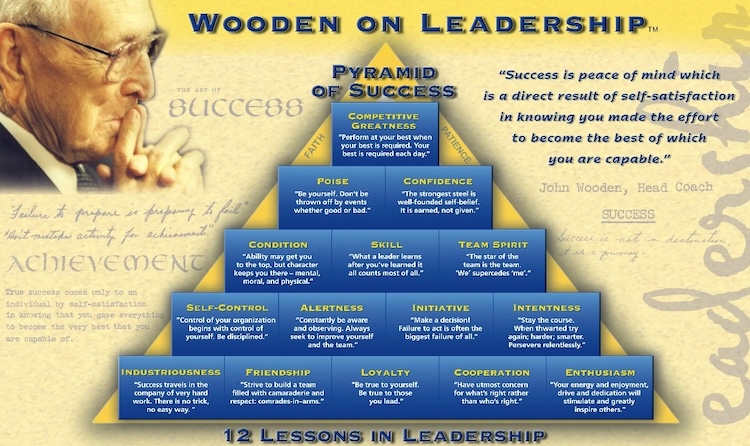
John Wooden, the legendary UCLA men’s basketball coach and winner of 10 NCAA championships in 12 years, spent more than a decade developing what became one of the most well-known frameworks for values-based success in the history of sport: the Pyramid of Success.

Wooden’s Pyramid contains 15 building blocks organized into five interconnected levels, beginning with a foundational base and culminating at the top with what he called Competitive Greatness. The two cornerstones of the entire structure are Industriousness and Enthusiasm — hard work ignited by genuine passion. From there, the pyramid builds through values including loyalty, cooperation, self-control, intentness, condition, skill, and team spirit.
Wooden defined success not as winning, but as “peace of mind which is a direct result of self-satisfaction in knowing you did your best to become the best you are capable of becoming.” That definition — rooted entirely in values and effort rather than outcomes — produced 10 national championships and influenced generations of coaches and athletes long after his retirement.
Crucially, Wooden believed character came before performance. As Cori Close — who was mentored by Wooden for 15 years — has reflected: “Coach Wooden talked about how the least of his concerns were a championship trophy and a banner. Those were the byproducts of being a great teacher of life and lessons about things that will live on long after the ball goes flat.”
That legacy of values-first coaching lives on in today’s most successful women’s basketball programs.
Cori Close, who led the UCLA Bruins to their first-ever NCAA women’s basketball national championship in 2026, has built one of the most values-driven programs in college basketball. Close is explicit about the three core values at the heart of her program: a growth mindset, gratitude, and being what she calls “lifestyle givers” — athletes who contribute to the people around them beyond just what they produce on the court.
Close recruits as much on these values as she does on talent. And the results speak for themselves.
Perhaps most powerfully, Close has described the ultimate purpose of her program this way: “Banners hang in gyms and rings collect dust, but who you become and who you impact in these four years, you get to keep forever.”
That is a values statement. And it’s one that has shaped an entire culture — and produced a national championship.
Dawn Staley, head coach of the South Carolina Gamecocks women’s basketball team and three-time NCAA national champion, has spoken and written extensively about the values that have shaped her both as a competitor and as a coach. In her instant New York Times bestselling memoir Uncommon Favor: Basketball, North Philly, My Mother, and the Life Lessons I Learned from All Three (2025), Staley reflects on how her upbringing in the North Philadelphia housing projects instilled in her the core values that have guided her entire career — discipline, community, faith, hope, and respect for the power of habits.
Those values didn’t just shape Staley as a person — they became the foundation of how she coaches. Her program is known for its demanding standards, deep player relationships, and culture of accountability. In her memoir, Staley talks about the importance and cost of living and competing in alignment with one’s core values. She says, “values and virtues are cheap until you have to pay for them, then they get really expensive.”
How to Identify Your Core Values
Whether you’re an athlete or a coach, the process of identifying your core values is the same: it requires honest reflection, and it takes more time than most people expect.
Here’s a process I use with athletes and coaches I work with:
Step 1: Start with Brené Brown’s list. Download or view the full values list here. Read through it slowly and circle every value that resonates with you — don’t edit yourself yet. Most people end up with 10–20 values circled.
Step 2: Group related values together. Look at your circled values and notice which ones cluster together. For example, you might have circled honesty, integrity, and authenticity — those are related. What’s the root value underneath all three? That root value is likely one of your core values.
Step 3: Narrow to your top two or three. This is the hardest part. Brown’s research shows that the athletes and leaders who live most intentionally tether their behavior to one or two values — not ten. Ask yourself: when I train or perform my best, which values are always present? When I’ve felt most out of alignment — most unlike myself — which values were being compromised? Are there some areas or domains of your life, that your core values feel more aligned with your actions and relationships?
Step 4: Write them down and define them in your own words. A value isn’t useful if it’s just a word on a list. Write a sentence or two about what each of your core values means to you, in the context of your sport and your life. What does “integrity” look like in practice during training and competition? How do your values show up in the face of setbacks or the most difficult moments of your season?
Step 5: Use them as a decision-making filter. The real test of values clarity comes in moments of pressure, conflict or uncertainty. When you face a hard decision or a relational conflict — whether to speak up, whether to let it go and push through, whether to make a change — ask yourself: What would the most values-aligned version of me do right now?Or how would your core-value respond to this situation?
Values for Coaches: Building a Values-Driven Team Culture
For coaches, establishing core values for athletes and teams is only the beginning. The next step is building a team culture that is explicitly grounded in those shared values.
This doesn’t mean imposing your values on your athletes. It means creating a process — at the beginning of each season or in preseason — where your team collectively identifies the values that will guide how they compete, how they treat each other, and how they respond to adversity.
When team values are co-created rather than handed down, athletes have a deeper sense of ownership and accountability. They are more likely to buy-in. They’re not following a coach’s rules — they’re honoring commitments they made to themselves and to one another as teammates.
A few practices that support values-driven team culture:
- Start each pre-season with a values identification exercise. Have each athlete identify their personal top two values and share them with the team. Hold space for hearing about why each team-member select their top values.
- Refer to team values explicitly during difficult moments — not as a lecture, but as a reminder: “We said we value resilience. What does that look like right now? If I watch you train or compete, will your core values be visible? What do your core values look like in the competition arena and in your relationships?”
- Recognize and celebrate athletes when athletes demonstrate values-aligned behavior — not just when they perform well.
- As a coach, model your own values publicly and consistently. Talk about what your values are and how they guide your decisions. Athletes notice.
The Bottom Line
Talent and hard work will only take you so far. But in the moments that matter most — when the pressure is highest, when outcomes are uncertain or out of your control, when career burnout starts take root — it’s your core values that will support your relationships and shape your legacy.
John Wooden didn’t win 10 national championships by focusing on trophies. Dawn Staley didn’t build three titles on talent alone. Cori Close didn’t win UCLA’s first-ever women’s basketball championship by focusing on banners. They built cultures grounded in clear, explicit, deeply held values — and those cultures produced champions.
The good news is that core values for athletes and coaches are available to everyone, at every level. It doesn’t require special talent or ideal circumstances. It doesn’t even cost money. It requires honesty, reflection, and the willingness to do the difficult inner work.
If you’re ready to start that process, Brené Brown’s values list is a powerful place to begin.
And if you’d like support identifying your core values and integrating them into your performance, leadership and life. I’d love to help. Book a free 15-minute consultation here.
Dr. Brooke Rundle at Headstrong Mindset combines evidence-based research with applied sport psychology strategies to help you reach your optimal potential, enjoy competing more and ultimately elongate your athletic career.
References
Brown, B. (2018). Dare to lead: Brave work, tough conversations, whole hearts. Random House.
Staley, D. (2025). Uncommon favor: Basketball, North Philly, my mother, and the life lessons I learned from all three. Atria/Black Privilege Publishing.
Wooden, J., & Jamison, S. (2005). Wooden on leadership. McGraw-Hill.
Wooden, J. (n.d.). Pyramid of success. The Official Site of Coach Wooden. https://coachwooden.com/pyramid-of-success
Deci, E. L., & Ryan, R. M. (1985). Intrinsic motivation and self-determination in human behavior. Plenum Press.
Weinberg, R. S., & Gould, D. (2019). Foundations of sport and exercise psychology (7th ed.). Human Kinetics.
Wilson, K. G., & Murrell, A. R. (2004). Values work in acceptance and commitment therapy. In S. C. Hayes, V. M. Follette, & M. M. Linehan (Eds.), Mindfulness and acceptance: Expanding the cognitive-behavioral tradition (pp. 120–151). Guilford Press.