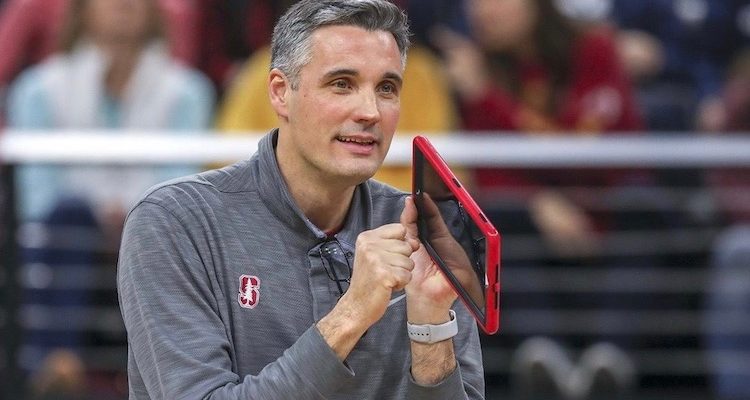
After inheriting the program in 2017, Kevin Hambly led the Cardinal women’s volleyball program to back-to-back NCAA national titles. In 2018 he was named the Pac-12 and AVCA Pacific North Region Coach of the Year. Prior to taking the helm as the Director of Women’s Volleyball at Stanford, he was the head coach at Illinois for eight seasons, where he led the Fighting Illini to six NCAA regional appearances and the 2011 national championships.
[Read more…] about In the Huddle with Kevin Hambly, Stanford University Volleyball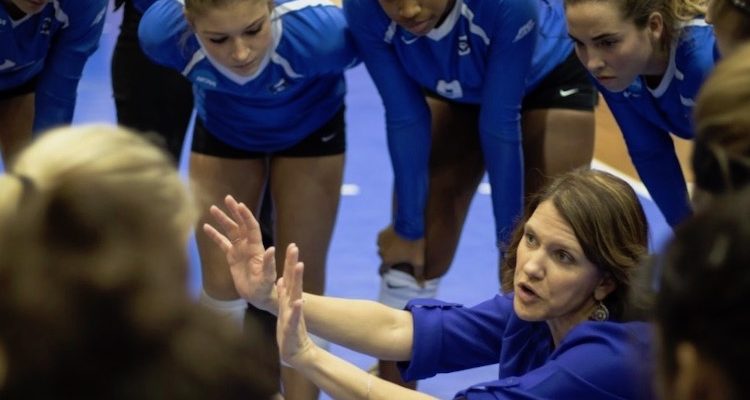
Inside the Huddle with Kirsten Bernthal Booth, Creighton University Head Volleyball Coach
When Kirsten Bernthal Booth took over the Creighton University Women’s Volleyball program in 2003, the team had a record of 3-23 the previous year. Since then, the Creighton women’s volleyball team has become one of only 10 Division 1 volleyball teams to be ranked in the year-end AVCA Top 25 poll each of the last five years. In 2015 Creighton had their first Sweet Sixteen appearance and in 2016 they made their first run to the Elite Eight.
The Kirsten Bernthal Booth that was hired back in 2003 inherited a team that won three games in a season. How did you convert the culture of your team to adopt a “winning mentality”.
I’ve always been a coach that believes in process. Doing the right things and not being totally locked into outcomes. To me, as an athlete and as a coach, that frees you a little bit. We’d really focus on process and taking risks. In a small way, if a player tipped, they were probably going to get yelled at. If they had a perfect set and they made a low risk decision, they were going to get in trouble with us. And if they had a good set and they went for it, regardless of outcome, we were going to cheer for that. It allowed them (the players) to go for it and know that there weren’t going to be ramifications. I know that sounds simple, but it really did switch the mentality. We’re a pretty high risk program. When you get a good ball, we’re going to go for it. It’s paid dividends because at the Division I level, if you give the other team that opportunity, they’re going to throw it down your throat, so we’ve got to seize it.
[Read more…] about Inside the Huddle with Kirsten Bernthal Booth, Creighton University Head Volleyball Coach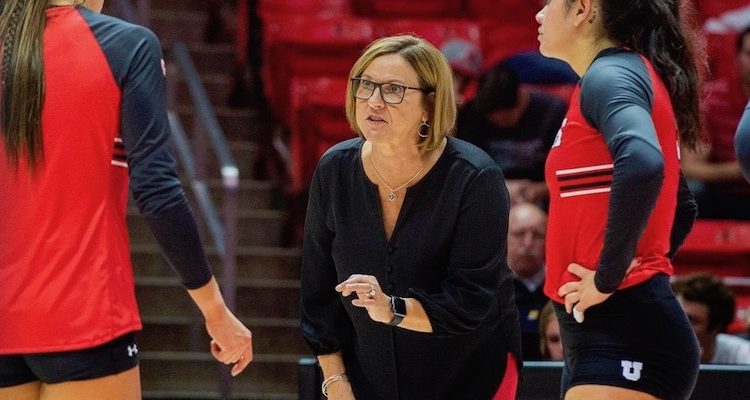
Interview with Beth Launiere on Preparing for NCAA Playoffs and Avoiding Player Burnout
2019 was a landmark year for Beth Launiere. Not only did it mark her 30th season as the Head Volleyball Coach at the University of Utah, but Launiere was named the Pac-12 Coach of the Year and led her team to the program’s fourth Sweet 16 performance. The team’s match up against BYU in the second round of the NCAA playoffs has gone down in Ute volleyball history.
[Read more…] about Interview with Beth Launiere on Preparing for NCAA Playoffs and Avoiding Player Burnout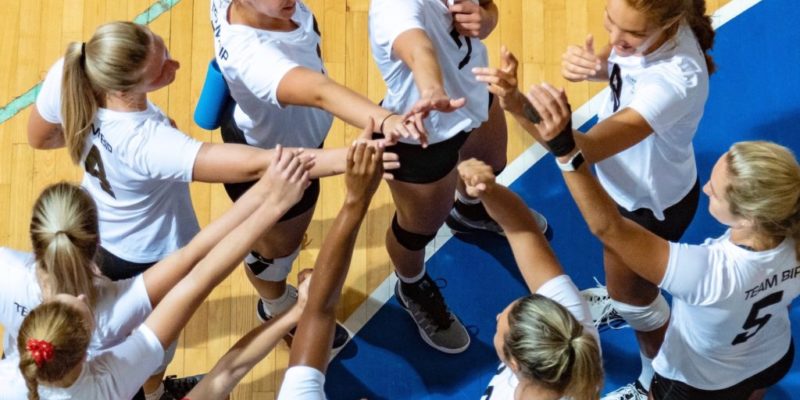
A Team Culture of Belonging vs Fitting In
There is a subtle but critical difference between a culture of belonging and fitting in. Creating a team culture of belonging is the key to melding a roster of over a dozen unique individuals into a single team with a shared sense of identity and purpose.
A culture of belonging starts with belief that every member of the team has an essential role to play. Finding and utilizing the unique assets of each player on your team will optimize your team’s potential. A culture of belonging celebrates each player’s uniqueness.
A fitting in culture on a team ostracizes players who are different than the majority and forces assimilation. Assimilation is the process in which a minority group comes to resemble or assume the values and behaviors of the dominant group. The consequence of assimilation is a loss of identity for the minority.
[Read more…] about A Team Culture of Belonging vs Fitting In
3 Myths About Flow
In 1964, famed psychologist Abraham Maslow originally coined the term “peak experience” to describe these periods of heightened concentration and self-actualization.
A few decades later the University of Chicago psychologist Mihaly Csikszentmihalyi coined the term “flow” to describe this state of optimal performance and intense focus in the present moment. NBA basketball player and coach Bill Russell of the Celtics describes the zone as, “as if we were playing in slow motion. During those spells I could almost sense how the next play would develop and where the next shot would be taken.”
Peak performance , flow and playing in the zone all describe a state of mind with a heightened state of consciousness that enables athletes to play at their optimal level. Many elite athletes who have won national championships and Olympic medals attribute their enhanced performance under extreme pressure to being in a state of flow or playing in the zone.
[Read more…] about 3 Myths About Flow
Planting Seeds
Our ancestors were deeply attuned to the seasons of the earth. They new when to plant seeds to harvest life sustaining vegetables and grains because they lived off the food they harvested from the seeds they planted.
For something to grow, a seed has to be planted in the dirt, underground, out of sight. The seed needs to be watered, but not over watered. It needs sunlight, but not too much sunlight. To harvest food from seeds, it takes patience and trust. You can care for it, fertilize it and protect it but you can’t speed up the process. The seed is going to grow at the natural rhythm of the earth. Our great ancestors understood this. They lived by this pace, this rhythm of the earth.
[Read more…] about Planting Seeds