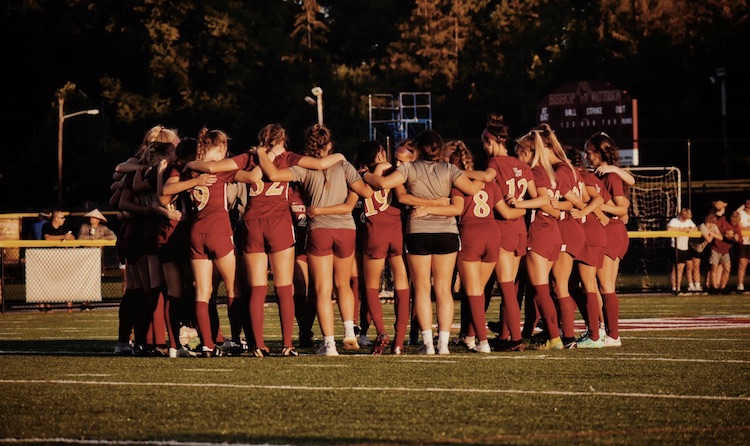
Every coach has experienced it: a roster full of talented athletes who, for whatever reason, just can’t seem to gel as a team. Conflicts simmer beneath the surface and go unresolved. Cliques form. Communication breaks down. And no matter how much talent is in the gym, the team consistently underperforms and falls short. What’s missing is team cohesion — and in sport, it’s the difference between a group of individuals and a genuine team.
They lack cohesion.
On the flip side, most coaches have also experienced the opposite — a team that maybe doesn’t have the most talented roster on paper, but competes with such unity, trust, and collective purpose that they consistently outperform expectations. Athletes communicate clearly. They hold each other accountable with compassion rather than criticism. They laugh together. They cry together. And when adversity hits — and it always does — they lean in rather than fall apart.
That’s what team cohesion feels like. And in my work as a mental performance consultant working with collegiate and elite athletic programs, building team cohesion is one of the most impactful things a coaching staff can invest in — because cohesion is what transforms a group of individual athletes into a genuine team.
Here’s what the research tells us about team cohesion in sport, what threatens it in today’s landscape, and how coaches can intentionally build it.
What Is Team Cohesion in Sport?
Carron, Brawley, and Widmeyer (1998) define team cohesion as:
“A dynamic process reflected in the tendency for a group to stick together and remain united in the pursuit of its instrumental objectives and/or for the satisfaction of member affective needs.”
Instrumental objectives are the task-related goals the team is working toward together. Thinkcommitment to the game plan, team roles and goals for the season. Basically, instrumental objectives are about winning games and titles.
On the other hand, affective needs are the emotional and social needs of the people in your program. The human need for a sense of belonging, feeling valued, connected and supported. It’s the “how we feel being part of this team” side.
Team cohesion isn’t just about teammates liking each other or being best friends on and off the court. It’s a dynamic process — something that shifts and evolves over the course of a season — and it serves two distinct purposes: pursuing shared goals and meeting the emotional and relational needs of individual members. Both matter.
The Stages of Team Development: Forming, Storming, Norming, Performing, and Adjourning
Understanding cohesion also means understanding that it develops over time — it doesn’t happen overnight. Bruce Tuckman’s model of group development, first proposed in 1965, describes the phases that are all necessary and inevitable in order for a team to grow, face up to challenges, tackle problems, find solutions, and deliver results. In 1977, Tuckman and Mary Ann Jensen added a fifth stage — adjourning — which involves completing the task and breaking up the team.
Here’s what each stage looks like in a collegiate sport context:
Forming — This is the beginning of the season or a new roster cycle. Athletes are getting to know each other, testing boundaries, and figuring out where they fit. There’s often excitement mixed with worry about acceptance and changing roles.
Storming — This is when things get uncomfortable. Members tend to experience competitiveness towards one another rather than the opponents as starting line-ups are being selected. Conflict over roles and between clashing personalities start to become visible. New leadership is being tested. These patterns often surface during preseason when there’s heightened competition for starting spots, early season losses, or when new team members are integrated into an established roster. Many teams get stuck here.
Norming — Now the team starts to find its rhythm and develop its unique culture. Members get to know each other more deeply, agree on norms, communication styles and conflict resolution strategies are established. Players accept their team roles, trust begins to solidify between teammates and coaches, and both task and social cohesion start to rise. This is when the group starts to feel like a team.
Performing — The team operates at a high level of efficiency, recognizing each member’s strengths and maintaining a strong commitment to shared goals. This is the stage every coach is trying to reach — and maintain — by the time conference play or postseason arrives. Cohesion is high, team leadership is clear, communication is efficient, and the team can self-regulate without coach intervention.
Adjourning — Every season must end. The group disbands, often eliciting mixed and complex emotions of disappointment, sadness, relief and joy. Coaches who acknowledge and honor this stage help athletes process transitions in healthy ways, which matters both for athlete well-being and athletic career endings for those athletes retiring. It also helps prepare those athletes who are staying for the next season.
One critical insight from Tuckman’s model: it is possible for a team to revert back to the storming stage when faced with obstacles such as injury, lineup or roster changes, or other season setbacks. This is why athlete transfers, injuries to key players, or significant coaching changes can feel like starting over — because in some ways, they are.
Task Cohesion vs. Social Cohesion in Sport
One of the most important distinctions in understanding team cohesion in sport is the difference between task cohesion and social cohesion. In my presentation at the NCAA WeCoach Women Coaches Academy on connectivity and communication, I laid out these two dimensions side by side — and the contrast is instructive.
Task cohesion is reflected in how unified a team is around its performance objectives. Task-cohesive teams share these characteristics:
- Committed to collective goals
- Role clarity, acceptance, and execution
- Willingness to sacrifice self for the team
- Trust in teammates’ ability
That third point deserves special attention. A willingness to sacrifice individual recognition, playing time, or personal playing time for the good of the team is one of the most powerful expressions of task cohesion — and one of the hardest to build. It requires athletes to genuinely trust both their teammates and their coaching staff.
Social cohesion reflects the quality of interpersonal relationships and the sense of community within the team:
- Genuine trust in teammates
- Enjoyment of being together & friendships within the team
- Participation in social activities
- A shared sense of belonging
Both types of cohesion matter — and they’re related, but they are not the same thing. Research suggests that task cohesion is more consistently linked to performance outcomes, while social cohesion tends to have a stronger impact on athlete satisfaction, well-being, and retention. The most resilient, high-performing teams tend to have both.
It’s also worth noting that the relationship between cohesion and inclusion matters deeply. Research by Mullin (2016) found that heterosexist attitudes within women’s collegiate athletic teams were negatively associated with team cohesion — meaning that teams where LGBTQ+ athletes feel unwelcome or unsupported experience measurably lower cohesion. Creating an affirming, inclusive team environment isn’t just the right thing to do — it’s a cohesion strategy.
The Reality: Modern Threats to Team Cohesion in Sport
Understanding what cohesion is matters. But coaches today are navigating a landscape that makes building and maintaining team cohesion more challenging than ever. The two biggest structural threats to cohesion in collegiate sport right now are the transfer portal and NIL.
The Transfer Portal has fundamentally changed roster stability in college athletics. As Coach Yolett McPhee-McCuin put it memorably: “The portal giveth and the portal taketh away.” In the 2026 offseason alone, eight Tennessee women’s basketball players transferred — with none returning. Roster turnover is no longer an occasional disruption — it’s an annual event. Coaches who once had three or four years to build cohesion with a stable core group are now rebuilding from scratch every offseason. This is the new NCAA landscape.
From a cohesion standpoint, this creates a significant challenge. Cohesion is built over time — through shared experience, vulnerable conversations, and the kind of trust that develops when teammates have trained and battled together. When roster turnover is significant every offseason, coaching staffs are essentially rebuilding cohesion from scratch each year. Tuckman’s model helps explain why this is so disruptive: every significant roster change risks sending a team back to the forming — or even storming — stage, regardless of how far along they were.
NIL (Name, Image, and Likeness) has introduced another layer of complexity. As NPR has reported, NIL contracts are changing the landscape of all collegiate sports — and with the NCAA’s new era of revenue sharing, the financial stakes have never been higher.
The Sports Conflict Institute has described this as the “NIL paradox”: the same financial opportunities that can help attract and retain athletes can also create internal tension when teammates have significantly different NIL deals, or when an athlete’s financial considerations compete with team loyalty.
The NCAA’s accelerating shift toward a professional model of sport means that athletes are now developing and managing personal brands — and those personal brands can quietly compete with team identity for an athlete’s primary allegiance. When an athlete’s NIL deal, social media following, or individual marketability becomes more central to their sense of self than their role within the team, the foundation of task cohesion begins to crack.
Perhaps most critically, the timeline for building cohesion has compressed dramatically. Where coaches once had years to develop trust, shared identity, and genuine team unity, many are now being asked to build meaningful cohesion in weeks or months. The biological and psychological processes that underpin trust and belonging haven’t changed — but the time available to develop them has shrunk significantly.
This means that intentional team-building at the start of a new season is more critical than ever before — because the landscape has changed.
Signs Your Team Has Strong Cohesion — and Signs It’s Breaking Down
Cohesion isn’t always easy to see directly, but its presence — or absence — shows up clearly in how a team behaves.
Signs of strong cohesion:
- Athletes communicate openly and constructively, both on and off the field
- Players hold each other accountable without it becoming personal or divisive
- The team responds to adversity — a bad loss, an injury, a tough stretch of the season — by pulling together rather than fragmenting
- Athletes celebrate each other’s successes genuinely
- There is a clear sense of shared purpose and collective identity
- Athletes report feeling valued, respected, and connected to their teammates
Signs cohesion is breaking down:
- Cliques are forming and hardening within the roster
- Communication between certain players has become strained or avoidant
- Athletes are disengaged in team settings but energized individually
- Frustration or blame is directed at teammates after poor performances
- Athletes are unclear about or resentful of their roles
- There is a growing gap between starters and the rest of the roster in terms of connection and investment
If you’re seeing multiple signs from that second list, it’s worth addressing proactively — because cohesion problems rarely resolve themselves, and they tend to compound under competitive pressure.
How Coaches Can Build Team Cohesion Intentionally
Cohesion doesn’t happen by accident. It’s built through deliberate choices about culture, communication, and leadership. Research by Kwon (2024), in a meta-analysis of team-building interventions in sport, confirms that structured team-building activities have a meaningful positive effect on cohesion — which means this isn’t just intuition. It’s evidence-based practice.
1. Start with Role Clarity
One of the most common sources of cohesion breakdown is role ambiguity. Coaches who invest time at the beginning of each season in clearly defining, communicating, and affirming each athlete’s role create the conditions for task cohesion to develop. Every athlete needs to understand not just what their role is, but why it matters to the team’s success. Establish and communicate clear role expectations for each team member. The athletes need to accept their roles and buy-in. Coaches should recognize and celebrate athletes who are performing their role responsibilities successfully
2. Build Shared Values and Team Identity
Cohesive teams have a clear sense of who they are and what they stand for. Invest time at the start of the season in a team values clarification process. What qualities do we want to be known for? How do we want to compete? How do we want to treat each other when things get hard? When team values are co-created rather than handed down, athletes feel a deeper sense of ownership and accountability. Read my past article to learn more about how to create individual and team core values.
3. Prioritize Trust-Building Experiences
Trust is the foundation of cohesion, and it’s built through consistent experiences of vulnerability, honesty, and follow-through. Team-building activities — done well — can accelerate this process. The key is choosing experiences that require genuine collaboration and communication, not just fun activities that keep athletes on the surface. At times this means you’re going to need to lean into hard conversations and people are going to disagree. That’s okay. We can agree to disagree, but we need to show respect to one another and maintain a sense of curiosity about each other’s lives.
4. Address Conflict Directly and Early
Conflict is inevitable on every team — and as Tuckman’s model reminds us, storming is a normal and necessary stage. What separates cohesive teams from fragmented ones isn’t the absence of conflict — it’s how conflict is handled. Don’t shy away from this step. Relational conflicts are normal for teams. Normalizing conflict and learning how to repair relationship ruptures within the team early in the season can pay huge dividends when it comes time for playoffs.
5. Create an Inclusive Team Environment
Research is clear that exclusion undermines cohesion. Coaches who actively work to create psychologically safe, affirming environments where every athlete feels a genuine sense of belonging are building the social cohesion foundation that high performance rests on. There’s an important distinction worth naming here: there’s a difference between a team culture of fitting in and a team culture of belonging. A fitting-in culture pressures sameness and social compatibility — athletes feel they have to hide or suppress parts of their identity to be accepted. A belonging culture is one where athletes can bring their authentic selves to practice and competition, and feel valued for their unique contributions to the team. I wrote about this in more depth in my article for the Junior Volleyball Association: 3 Ways to Cultivate a Culture of Belonging.
Assessments I Use to Evaluate Team Cohesion in Sport
When I work with athletic programs on team cohesion in sport, I use validated assessment tools to get an objective picture of where the team stands. Two of the most useful are:
The Group Environment Questionnaire (GEQ) — developed by Widmeyer, Brawley, and Carron (1985), the GEQ measures both task and social cohesion across group integration and individual attraction dimensions.
The Athlete Satisfaction Questionnaire (ASQ) — developed by Riemer and Chelladurai (1998), the ASQ evaluates athlete satisfaction across multiple dimensions including training, personal treatment, team performance, and individual performance.
The Team Psychological Safety Scale (TPS-7) — developed by Amy Edmondson (1999), Harvard Business School professor and leading researcher on team effectiveness, the TPS-7 is a 7-item self-report measure that assesses whether athletes feel safe to take interpersonal risks within the team environment — things like asking questions, admitting mistakes, raising concerns, or challenging the status quo without fear of embarrassment, rejection, or punishment.
I use the TPS-7 alongside the GEQ and ASQ to give coaching staffs a three-dimensional picture of team health: how cohesive the team is around goals and roles, how satisfied individual athletes are, and how safe athletes feel to show up fully and honestly within the team environment. Together, these tools give me — and the coaching staff — a much clearer picture of where cohesion is strong and where it needs attention.
The Leadership Connection: Cohesion Alone Isn’t Enough
One of the most important things to understand about team cohesion in sport is that it’s necessary but not sufficient for optimal performance. A team can have high cohesion — strong bonds, genuine trust, a real sense of unity — and still underperform if they lack direction, motivation, or effective leadership.
Think of it this way: cohesion is the fuel, but leadership is the engine. Without strong leadership — both from coaches and from peer leaders within the roster — even the most cohesive team can lack the direction and accountability structures needed to translate that unity into results.
The most successful programs I’ve worked with have both: a genuine sense of team cohesion built on trust and shared values, and clear, effective leadership that channels that cohesion toward collective performance goals.
The Bottom Line
Team cohesion in sport is one of the most powerful performance variables in athletics. It doesn’t show up in a stat line or a scouting report, but its presence or absence if felt and it shapes everything from how a team responds to a tough loss to how athletes perform under pressure late in a season.
In today’s collegiate landscape — with transfer portal volatility, NIL complexity, and rosters that can look dramatically different year over year — building cohesion intentionally isn’t optional. It’s one of the most important things a coaching staff can do.
The investment pays dividends: in performance, in athlete well-being, in retention, and in the kind of team culture that athletes carry with them long after their playing days are over.
If you’d like support assessing and building cohesion within your program, I’d love to connect. Book a free 15-minute consultation here.
If you’re a coach who wants to be intentional about building culture from day one of preseason, I’d love to work with your program. Find out more about team mental performance workshops here.
Headstrong Mindset combines evidence-based research with applied sport psychology strategies to help you reach your optimal potential, enjoy competing more, and ultimately elongate your athletic career.
References
Carron, A. V., Brawley, L. R., & Widmeyer, W. N. (1998). The measurement of cohesion in sport and exercise: Some practical considerations. Journal of Sport & Exercise Psychology.
Carron, A. V., & Hausenblas, H. A. (1998). Group dynamics in sport (2nd ed.). Fitness Information Technology.
Aoyagi, M., Cox, R., & McGuire, R. (2008). Organizational citizenship behavior in sport: Relationships with leadership, team cohesion, and athlete satisfaction. Journal of Applied Sport Psychology, 20(1), 25–41.
Burke, S. M., Davies, K., & Carron, A. V. (2014). Group cohesion in sport and exercise settings. In M. R. Beauchamp & M. A. Eys (Eds.), Group dynamics in exercise and sport psychology (2nd ed.). Routledge.
Edmondson, A. C. (1999). Psychological safety and learning behavior in work teams. Administrative Science Quarterly, 44(2), 350–383.
Fransen, K., McEwan, D., & Sarkar, M. (2020). The impact of identity leadership on team functioning and well-being in team sport: Is psychological safety the missing link? Psychology of Sport and Exercise, 51, Article 101763.
Gardner, D. E., Shields, D. L. L., Bredemeier, B. J. L., & Bostro, A. (1996). The relationship between perceived coaching behaviors and team cohesion among baseball and softball players. The Sport Psychologist, 10, 367–381.
Kwon, S. H. (2024). Analyzing the impact of team-building interventions on team cohesion in sports teams: A meta-analysis study. Frontiers in Psychology, 15, Article 1353944. https://doi.org/10.3389/fpsyg.2024.1353944
Mullin, E. M. (2016). Heterosexist attitudes and team cohesion in women’s collegiate athletics. Journal of Intercollegiate Sport, 9(1), 90–105. https://doi.org/10.1123/jis.2015-0009
Riemer, H. A., & Chelladurai, P. (1998). Development of the Athlete Satisfaction Questionnaire (ASQ). Journal of Sport and Exercise Psychology, 20(2), 127–156.
Shapiro, A., Fuller, J., & Mehta, J. (2022, March 28). NIL contracts are changing the landscape of all collegiate sports. NPR. https://www.npr.org/2022/03/28/1089311065/nil-contracts-are-changing-the-landscape-of-all-collegiate-sports
Sports Conflict Institute. (2025, November 7). The NIL paradox: How financial opportunity tests team cohesion in college sport. https://sportsconflict.org/the-nil-paradox-how-financial-opportunity-tests-team-cohesion-in-college-sport/
Taylor, R. (2026, April 29). “The portal giveth and the portal taketh away”: Coach Yo speaks on women’s basketball transfers. The Daily Mississippian. https://thedmonline.com/the-portal-giveth-and-the-portal-taketh-away-coach-yo-speaks-on-womens-basketball-transfers/
The Washington Post. (2025, August 21). In NCAA’s new era of revenue sharing, smaller schools try to keep up. https://www.washingtonpost.com/sports/2025/08/21/ncaa-revenue-sharing-morgan-state/
Tuckman, B. W. (1965). Developmental sequence in small groups. Psychological Bulletin, 63(6), 384–399.
Tuckman, B. W., & Jensen, M. A. C. (1977). Stages of small-group development revisited. Group & Organization Studies, 2(4), 419–427.
Weinberg, R. S., & Gould, D. (2019). Foundations of sport and exercise psychology (7th ed.). Human Kinetics.
Widmeyer, W. N., Brawley, L. R., & Carron, A. V. (1985). The measurement of cohesion in sport teams: The Group Environment Questionnaire. Sports Dynamics.